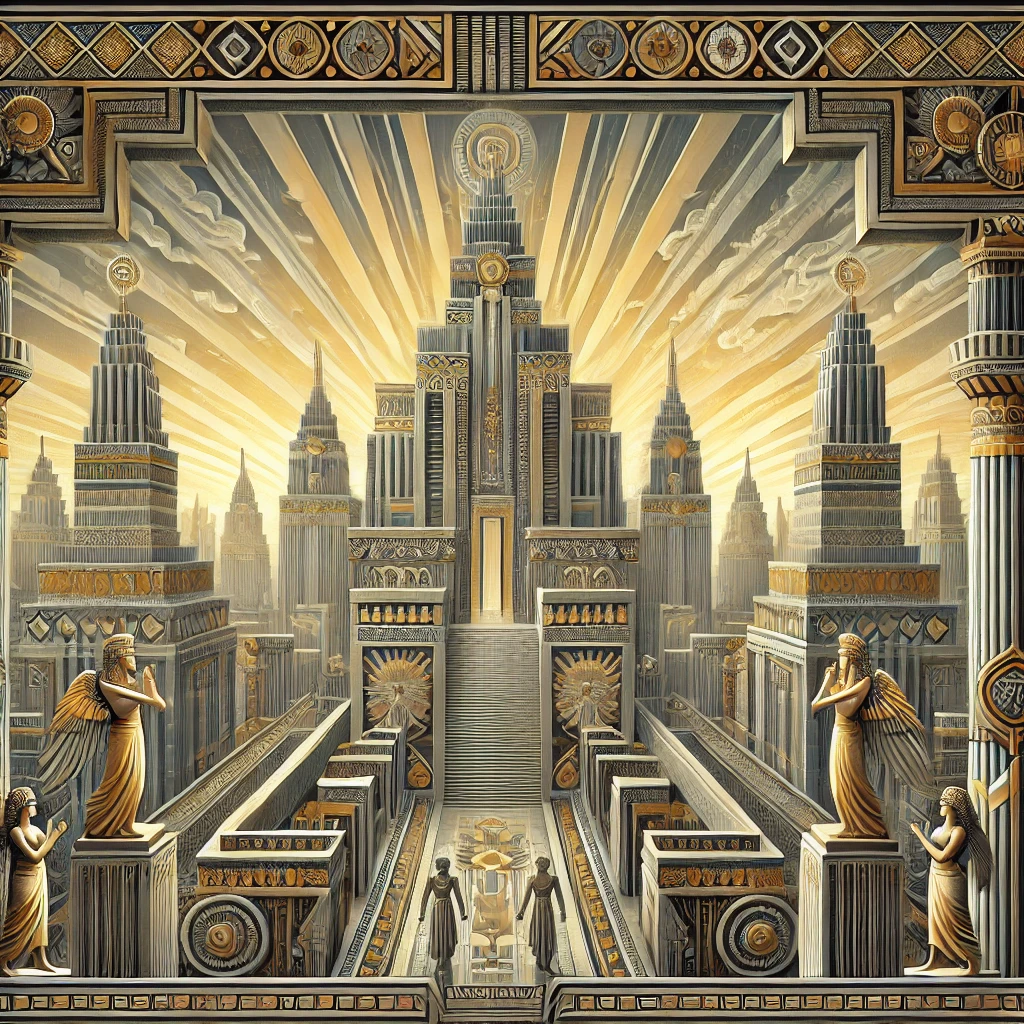
Death and the Toll-Houses
Written by Vladimir Moss
DEATH AND THE TOLL-HOUSES It is decreed that men should die once, and after that the judgement.
The Orthodox tradition on the judgement of the soul after death, and the
passage of the soul through the “toll-houses”, was summarized by St.
Macarius the Great as follows: “When the soul of man departs out of the body,
a great mystery is there accomplished. If it is under the guilt of sins, there
come bands of demons, and angels of the left hand, and powers of darkness
that take over that soul, and hold it fast on their side. No one ought to be
surprised at this. If, while alive and in this world, the man was subject and
compliant to them, and made himself their bondsman, how much more, when
he departs out of this world, is he kept down and held fast by them. That this
is the case, you ought to understand from what happens on the good side.
God’s holy servants even now have angels continually beside them, and holy
spirits encompassing and protecting them; and when they depart out of the
body, the hands of angels take over their souls to their own side, into the pure
“Like tax-collectors sitting in the narrow ways, and laying hold upon the
passers-by, so do the demons spy upon souls and lay hold of them; and when
they pass out of the body, if they were not perfectly cleansed, they do not
suffer them to mount up to the mansions of heaven and to meet their Lord,
and they are driven down by the demons of the air. But if whilst they are yet
in the flesh, they shall with much labour and effort obtain from the Lord the
grace from on high, assuredly these, together with those who through
The first major exposition of this tradition in modern times was Bishop
Ignatius Brianchaninov’s
Essay on Death in the third volume of his Collected
Works. (Later, he added a “Reply” to the objections of a certain priest called Matveevsky. See Polnoe Zhizneopisanie Svititelia Ignatia Kavkazkogo, Moscow, 2002, pp. 450-488 (in Russian).)
St. Barsanuphius of Optina called this Essay “indispensable” in its genre”. (Victor Afanasiev, Elder Barsanuphius of Optina, Platina, Ca.: St. Herman of Alaska Brotherhood, 2000, p. 736). In recent years this teaching has been challenged by OCA Archbishop Lazarus (Puhalo) (“The Soul, The Body and Death”, Orthodoxy Canada, vols. 6-7 (1979-80).) Although refuted both by Hieromonk Seraphim Rose (The Soul after Death, Platina, 1980, 2004) and by the Holy Synod of the Russian Orthodox Church Abroad (“Extract from the Minutes of the Session of the Synod of Bishops of the Russian Orthodox Church Outside of Russia”, Orthodox Life, vol. 31, no. 1, January-February, 1981, pp. 23-27), Puhalo’s thesis continues to be received doctrine in HOCNA and elsewhere, and elicits passionate support on Orthodox list-forums. It may be useful, therefore, to review some of the major arguments.Is the Toll-House Teaching Gnostic?
The idea that the toll-house teaching is Gnostic is refuted by the support
given it by many Holy Fathers. A very large body of evidence in favour of the
toll-houses from scriptural, patristic, hagiographical and liturgical sources
was amassed by Rose in the book alluded to above. According to Puhalo,
however, many of these sources are either apocryphal (e.g. St. Cyril of
Alexandria’s
Homily on the Departure of the Soul from the Body) or influenced by
Egyptian Gnostic ideas (e.g. the
Homilies of St. Macarius the Great, quoted
above) or the products of western heretical concepts concerning Divine justice,
purgatory, etc. (e.g. the stories in St. Gregory the Great’s
Dialogues or the
Venerable Bede’s
Ecclesiastical History of the English Church and People).Since the present writer is not competent to discuss questions of textual
authenticity, the rest of this article will be based on authorities and writings
whose authenticity has never been questioned - in Orthodox circles, at any
rate.
St. Athanasius the Great writes in his
Life of Saint Anthony that one night
the saint received “a call from on high, saying, ‘Anthony! Rise, go out and
look!’ He went out therefore – he knew which calls to heed – and, looking up,
saw a towering figure, unsightly and frightening, standing and reaching to
the clouds; further, certain beings ascending as though on wings. The former
was stretching out his hands; some of the latter were stopped by him, while
others flew over him and, having come through, rose without further trouble.
At such as these the monster gnashed with his teeth, but exulted over those
who fell. Forthwith a voice addressed itself to Anthony, ‘Understand the
vision!’ His understanding opened up, and he realized that it was the passing
of souls and that the monster standing there was the enemy, the envier of the
faithful. Those answerable to him he lays hold of and keeps them from
passing through, but those whom he failed to win over he cannot master as
they pass out of his range. Here again, having seen this and taking it as a
reminder, he struggled the more to advance from day to day in the things that
Anthony’s disciple, Abba Ammonas, spoke of the power of the Holy Spirit
enabling us to pass all “the powers of the air” (Ephesians 2.2) after death: “For
this is the power which He gives to me here; it is this, again, which guides
men into that rest, until he shall have passed all the ‘powers of the air’. For
there are forces at work in the air which hinder men, preventing them from
The theologian Nikolaos P. Vasileiades writes: “After his death poor man
Lazarus ‘was received up by the angels’ (Luke 16.22). Angels, however,
accompany not only the souls of the just, but also those of evil men, as the
divine Chrysostom comments, basing his words on what God said to the
foolish rich man: ‘Fool, this night will they require thy soul from thee’ (Luke
12.20). So while good angels accompanied the soul of Lazarus, the soul of the
foolish rich man ‘was required by certain terrible powers who had probably
been sent for this reason. And the one (the rich man) they led away ‘as a
prisoner’ from the present life, but Lazarus ‘they escorted as one who had
been crowned’. St. Justin the philosopher and martyr, interpreting the word of
the psalm, ‘Rescue my soul from the sword, and this only-begotten one of
mine from the hand of the dog; save me from the mouth of the lion’ (Psalm
21.21-22), comments: By this we are taught how we also should seek the same
from God when we approach our departure from this life. For God alone can
“Basil the Great relates that the holy martyr Gordius (whose memory is
celebrated on January 3
rd) went to martyrdom not as if he was about to meetthe public, but as if he was about to hand himself over into the hands of
angels who immediately, since they received him as ‘newly slaughtered’,
would convey him to ‘the blessed life’ like the poor man Lazarus. In another
place, the holy Father, with reasons (at that time men used to be baptized at a
great age), said: Let no one deceive himself with lying and empty words
(Ephesians 5.6); for the catastrophe will come suddenly upon him (I
Thessalonians 5.3); it will come like a tempest. There will come ‘a sullen
angel’ who will lead away your soul which will have been bound by its sins;
and your soul will then turn within itself and groan silently, for the further
reason, moreover, that the organ of lamentation (the body) will have been cut
off from it. O how you will wail for yourself at that hour of death! How you
will groan!
“The Lord’s words: ‘The ruler of the world cometh, and has nothing in Me’
(John 14.3) are interpreted by St. Basil as follows: Satan comes, who has power
over men who live far from God. But in Me he will find nothing of his own
that might give him power or any right over Me. And the luminary of
Caesarea adds: The sinless Lord said that the devil would not find anything in
Him which would give him power over Him; for man, however, it is
sufficient if he can be so bold as to say at the hour of his death that the ruler of
this world comes and will in me only a few and small sins. The same Father
says in another place that the evil spirits watch the departure of the soul more
vigilantly and attentively than ever enemies have watched a besieged city or
thieves a treasury. St. Chrysostom calls ‘customs-officers’ those ‘threatening
angels and abusive powers’ of terrible appearance, meeting whom the soul is
seized with trembling; and in another place he says that these ‘persecutors are
“In that temporary state [between the death of the body and the Last
Judgement] the just live under different conditions from the sinners.
According to St. Gregory the Theologian, every ‘beautiful and God-loving’
soul has scarcely been parted from the body when it experiences a
‘wonderful’ inner happiness because of all the good things that await it in
endless eternity. For this reason ‘it rejoices’ and goes forward redeemed,
forgiven and purified ‘to its Master’ since it has left the present life which was
like an unbearable prison. On the other hand, the souls of the sinners are
drawn ‘to the left by avenging angels by force in a bound state until they are
near gehenna’. From there, as they face ‘the terrible sight of the fire’ of
punishment, they tremble in expectation ‘of the coming judgement’ and are
already punished ‘in effect’ (St. Hippolytus). For the whole time that they are
separated from their bodies they are not separated from the passions which
had dominion over them on earth, but they bear with them their tendency to
sin. For that reason their suffering is the more painful (St. Gregory of
Visions of the passage through the toll-houses are common also in the
Lives of the Celtic saints. Thus we read about St. Columba of Iona that “one day he
suddenly looked up towards heaven and said: ‘Happy woman, happy and
virtuous, whose soul the angels of God now take to paradise!’ One of the
brothers was a devout man called Genereus, the Englishman, who was the
baker. He was at work in the bakery where he heard St. Columba say this. A
year later, on the same day, the saint again spoke to Genereus the Englishman,
saying: ‘I see a marvelous thing. The woman of whom I spoke in your
presence a year ago today – look! – she is not meeting in the air the soul of a
devout layman, her husband, and is fighting for him together with the holy
angels against the power of the enemy. With their help and because the man
himself was always righteous, his soul is rescued from the devils’ assaults and
Coming to our own age, we have mentioned the witness of the holy
Bishop Ignatius Brianchaninov and Elder Barsanuphius of Optina. Still closer
to our time is St. John Maximovich (+1966), who writes: “Many appearances
of the dead have given us to know in part what happens with the soul when it
leaves the body. When it no longer sees with its bodily eyes, its spiritual
vision is opened. This frequently occurs even before actual death; while
seeing and even conversing with those around them, the dying see that which
others do not. Leaving the body, the soul finds itself among other spirits,
good and evil. Usually it strives towards those which are more akin to it, but
if while still in the body it was under the influence of certain spirits, it remains
dependent upon them when it leaves the body, no matter how unpleasant
“For two days the soul enjoys relative freedom and can visit its favourite
places on earth, but on the third day it makes its way towards other realms.
At this time it passes through a horde of wicked spirits, who obstruct its path
and accuse the soul of various sins by which they themselves had deceived it.
According to revelations, there are twenty such barriers, so-called ‘tollhouses’.
At each stop the soul is tested as to a particular sin. Passing through
one, the soul comes upon the next, and only after successfully passing
through them all can the soul continue its way, and not be thrown
straightway into hell. These demons and their trials are so horrendous that
the Mother of God herself, when informed by Archangel Gabriel of her
imminent repose, entreated her Son to deliver her from those demons and, in
fulfillment of her prayer, the Lord Jesus Christ Himself appeared from
Heaven to take the soul of His Most Pure Mother and carry it up to Heaven.
“Once having safely passed through the toll-houses and having bowed
down before God, the soul spends the next thirty-seven days visiting the
heavenly habitations and the chasms of hades, not knowing where it will find
itself, and only on the fortieth day is it assigned its place of waiting until the
resurrection of the dead. Some souls find themselves with a foretaste of
eternal joy and blessedness, while others – in fear of eternal torments, which
will begin in earnest after the Dread Judgement. Until that time, changes in
the state of the soul are still possible, especially through offering for their sake
the Bloodless Sacrifice (commemoration at the Divine Liturgy), and likewise
Descriptions of the passage of souls through the toll-houses are to be found
in the Orthodox literature of many ages and nations. Such universality is in
To Whom Belongs the Judgement?
Puhalo also argues that the toll-house tradition is heretical on the grounds
that it implies that the judgement of souls after death is not God’s but the
demons’. Moreover, it is very close, he claims, to the papist doctrine of
purgatory. For “the difference between the purgatory myth and that of the
aerial toll-houses is that the one gives God satisfaction by means of physical
torment, while the other gives Him His needed satisfaction by means of
To discuss the role of justice and its satisfaction would take us too far from
the subject of the toll-houses. Therefore suffice it to say that while all judgement of souls is in the hands of God, He often uses created beings as the instruments of His
justice, just as a judge might use lawyers for the prosecution and defence, or a
king might use an executioner. Thus we think of the avenging Angel who
slew all the first-born of Egypt, and of the Archangel Michael’s destruction of
the 185,000 warriors of Sennacherib. And it is not only good angels who carry
out His will in this way: the other plagues of Egypt were “a mission
performed by evil angels” (Psalm 77.53). We are not tempted to think, in these
cases, that God has lost control: He is simply executing His will through
Similarly, we should not think that God is not carrying out His own
judgement when he allows the soul to be tested at the toll-houses. Here God is
revealing His judgement on a soul through the agency, on the one hand, of
demons, who, like counsel for the prosecution, bring up all the evil things that
the soul has thought or done, and, on the other hand, of the good angels, who,
like counsel for the defence, bring up its good deeds. Moreover, insofar as it is
the good angels who encourage men to good deeds, and the demons who
incite them to evil, this procedure actually reveals to the soul the hidden
Thus there is no contradiction, contrary to Puhalo’s assertion, between the
demons’ testing souls at the toll-houses and the final judgement of sinners
being delivered by God Himself, Who “cuts them off from the Holy Spirit”.
Of course, God has no need for a detailed examination of our thoughts and
deeds; it is
we who, in accordance with His justice, are required to come to a
full consciousness of them. For the Lord Himself said: “Every idle word that
men shall speak, they shall give an account of in the day of judgement”
(Matthew 12.36). Sinners who fail the searching test of their conscience at the
toll-houses are indeed cut off from the Holy Spirit, and their souls are “cast
into prison” (Matthew 5.25), the prison of hades, of spiritual darkness and
excommunication from God, until the final judgement of soul and body
together on the last day. Thus while angels accuse and excuse, it is God alone
who delivers the final verdict; He alone decides the soul’s destiny.
Moreover, in His mercy God often “tips the balance” in favour of the sinner when the demons appear to have won the case. Thus in the
came out and said with anger: ‘This is our soul; how do you dare to carry him past us?’ The angels replied: ‘What kind of sign do you have on this soul, that you consider it yours?’ The demons said: ‘It defiled itself before death with sin, not only natural ones but even unnatural ones; besides that, it judged its neighbour and died without repentance. What do you say to that?’
‘We will not believe,’ said the angels, ‘either you or your father the devil, until
we ask the guardian angel of this soul.’ And when they asked him, he said: ‘It
is true that this soul sinned much, but when it got sick it began to weep and
confess its sin before God; and if God has forgiven it, He knows why: He has
the authority. Glory be to His righteous judgement!’ Then the angels, having
put the demons to shame, entered the heavenly gates with that soul. Then the
blessed one saw the angels carrying yet another soul, and the demons ran out
to them and cried out: ‘Why are you carrying souls without knowing them?
For example, you are carrying this one, who is a lover of money, a bearer of
malice, and an outlaw.’ The angels replied: ‘We well know that it did all these
things, but it wept and lamented, confessed its sins, and gave alms; for this
God has forgiven it.’ But the demons began to say: ‘If even this soul is worthy
of God’s mercy, then take and carry away the sinners from the whole world.
Why should we be labouring?’ To this the angels replied: ‘All sinners who
confess their sins with humility and tears receive forgiveness by God’s mercy;
This shows, on the one hand, that the demons are essentially powerless,
and on the other, that such authority as they possess over souls is ceded to
them by the souls themselves when they willingly follow their enticements.
For the Lord said: “He who sins is the servant of sin” (John 8.34), and
therefore of him who is the origin and instigator of sin, the devil. If the
demons have power even in this life over those who willingly follow their
suggestions, what reason have we for believing that these souls do not
continue in bondage after their departure from the body? However, if we
resist sin and the devil in this life, they will have no power over us in the next.
For, as St. Anthony says: “If the demons had no power even over the swine,
much less have they any over men formed in the image of God. So then we
The Toll-Houses and Purgatory
But if the judgement of souls after death is not in any real sense a
judgement by the devil, as opposed to God, much less is it a purging of souls
in the papist sense. At most, the fear experienced on passing through the tollhouses
can to some extent purify the soul. That this is admitted by the
Orthodox Church is shown by the following reply of St. Mark of Ephesus to
the Roman cardinals on purgatory: “At the beginning of your report you
speak thus: ‘If those who truly repent have departed this life in love (towards
God) before they were able to give satisfaction by means of worthy fruits for
their transgressions or offences, their souls are cleansed after death by means
of purgatorial sufferings; but for the easing (or ‘deliverance’) of them from
these sufferings they are aided by the help which is shown them on the part
of the faithful who are alive, as for example: prayers, Liturgies, almsgiving,
“To this we answer the following: of the fact that those reposed in faith are
without doubt helped by the Liturgies and prayers and almsgiving performed
for them, and that this custom has been in force since antiquity, there is the
testimony of many and various utterances of the Teachers, both Latin and
Greek, spoken and written at various times and in various places. But that
souls are delivered thanks to a certain purgatorial suffering and temporal fire
which possesses such (a purgatorial) power and has the character of a help –
this we do not find either in the Scriptures or in the prayers and hymns for the
dead, for in the words of the Teachers. But we have received that even the
souls which are held in hell and are already given over to eternal torments,
whether in actual fact and experience or in hopeless expectation of such, can
be aided and given a certain small help, although not in the sense of
completely loosing them from torment or giving hope for a final deliverance.
And this is shown from the words of the great Macarius the Egyptian ascetic
who, finding a skull in the desert, was instructed by it concerning this by the
action of Divine power. And Basil the Great, in the prayers read at Pentecost
writes literally the following: ‘Who also, on this all-perfect and saving feast,
art graciously pleased to accept propitiatory prayers for those who are
imprisoned in hell, granting us a great hope of improvement for those who
are imprisoned from the defilements which have imprisoned them, and that
Thou wilt send down Thy consolation’ (Third Kneeling Prayer at Vespers).
“But if souls have departed this life in faith and love, while nevertheless
carrying away with themselves certain faults, whether small ones over which
they have not repented at all, or great ones for which – even though they have
repented over them – they did not undertake to show fruits of repentance:
such souls, we believe, must be cleansed from this kind of sins, but not by
means of some purgatorial fire or a definite punishment in some place (for
this, as we have said, has not at all been handed down to us). But some must
be cleansed in the very departure from the body, thanks only to fear, as St.
Gregory the Dialogist literally shows; while others must be cleansed after the
departure from the body, either while remaining in the same earthly place,
before they come to worship God and are honoured with the lot of the blessed,
or – if their sins were more serious and bind them for a longer duration – they
are kept in hell, but not in order to remain forever in fire and torment, but as
“All such ones, we affirm, are helped by the prayers and Liturgies
performed for them, with the cooperation of the Divine goodness and love for
mankind. This Divine cooperation immediately disdains and remits some sins,
those committed out of human weakness, as Dionysius the Great (the
Areopagite) says in
Reflections on the Mystery of those Reposed in the Faith (in The
Ecclesiastical Hierarchy
, VII, 7); while other sins, after a certain time, byrighteous judgements it either likewise releases and forgives – and that
completely – or lightens the responsibility for them until that final Judgement.
And therefore we see not necessity whatever for any other punishment or for
a cleansing fire; for some are cleansed by fear, while others are devoured by
the gnawings of conscience with more torment than any fire, and still others
are cleansed by the very terror before the Divine glory and the uncertainty as
to what the future will be. And that this is much more tormenting and
punishing than anything else, experience itself shows…” (St. Mark of Ephesus, “First Homily on Purgatorial Fire”, The Orthodox Word,
March-April, 1978)
Thus while St. Mark rejected the idea of a purging by fire as the cardinals
understood it, he definitely accepted the notion of a purging by fear and the
gnawings of conscience. Now the experience of the soul after death which
Orthodox writers describe by means of the toll-house metaphor is certainly an
experience which includes fear and the gnawings of conscience. We may
therefore conclude that there is nothing heretical in the notion of the tollhouses
– provided we remember that it is a metaphor and not a literal
Soul-Sleep?
A third set of objections raised by Puhalo is based on the teaching that the
soul when separated from the body cannot, by its nature, have such
experiences as are attributed to it by the Orthodox teaching. For “the notion
that the soul can exit the body, move about, have experiences, receive visions,
revelations, wander from place to place, make progress or be examined and
judged without the body, is essentially Origenistic, and is derived from the
philosophies of the pagan religions of Greece and elsewhere… Old Testament
anthropology, like that of the New Testament, never conceived of an
immortal soul inhabiting a moral body from which it might be liberated, but
always conceived a simple, non-dualistic anthropology of a single,
psychophysical organism. And active, intellectual life or functioning of the
soul alone could never be conceived in either Old or New Testament thought.
For the soul to function, its restoration with the body as the ‘whole person’
would be absolutely necessary.”
At the same time, Puhalo accepts that thesoul has “some consciousness of future destiny, some hope”, and is “neither
dead nor devoid of spiritual sensations”. (Puhalo, op. cit., pp. 31, 33)
The question arises: why should not the experiences that the Orthodox
teaching attributes to the soul after death be accounted as “spiritual
sensations”? We have seen, for example, that according to St. Basil the
indolent soul after death “groans silently” because “the organ of lamentation
(the body) will have been cut off from it”. So while it cannot lament in the
way it did before, the soul still laments – in a disincarnate, bodiless way.
Similarly, it sees without eyes and hears without ears. These “spiritual”
experiences are certainly different from their analogues in the sensual world,
The difference between the spiritual and sensual senses is well illustrated
by the following: “they used to tell a story of a certain great old man, and say
that when he was traveling along a road two angels cleaved to him and
journeyed with him, one on his right hand and the other on his left. And as
they were going along they found lying on the road a dead body which stank,
and the old man closed his nostrils because of the evil smell, and the angels
did the same. Now after they had gone on a little farther, the old man said
unto them, ‘Do ye also smell as we do?’ And they said unto him, ‘No, but
because of thee we closed our nostrils. For it is not for us to smell the
rottenness of this world, but we do smell the souls which stink of sin, because
It is not only angels who have these spiritual senses: to the degree that a
man is purified he may also see, hear and smell spiritually even while in the
body: “It came to pass that when the old man [St. Pachomius the Great] had
said these thing to the brethren, the door-keeper came to him and said:
‘Certain travelers, who are men of importance, have come hither, and they
wish to meet thee.’ And he said: ‘Call them hither.’ And when they had seen
all the brotherhood, and had gone round all the cells of the brethren they
wanted to hold converse with him by themselves. Now when they had taken
their seats in a secluded chamber, there came unto the old man a strong smell
of uncleanness though he thought that it must arise from them because he
was speaking with them face to face; and he was not able to learn the cause of
the same by the supplication which [he made] to God, for he perceived that
that their speech was fruitful [of thought] and that their minds were familiar
with the Scriptures, but he was not acquainted with their intellectual
uncleanness. Then, after he had spoken unto them many things out of the Divine Books, and the season of the ninth hour had drawn nigh meanwhile, they rose up that they might come to their own place, and Rabba entreated them to partake of some food there but they did not accept [his petition, saying] that they were in duty bound to arrive home before sunset; so they“And Abba, in order to learn the cause of the uncleanness of these men,
went into his cell, and prayed to God; and he knew straightway that it was
the doctrine of wickedness which arose from their souls and pursued these
men, and having overtaken them, he said unto them, ‘Do ye call that which is
written in the works of Origen heresy?’ And when they had heard the
question they denied and said that they did not. Then the holy man said unto
them, ‘Behold, I take you to witness before God, that every man who readeth
and accepteth the work of Origen, shall certainly arrive in the fire of Sheol,
and his inheritance shall be everlasting darkness. That which I know from
God I have made you to be witnesses of, and I am therefore not condemned
by God on this account, and ye yourselves know about it. Behold, I have
made you hear the truth. And if ye believe me, and if ye wish to gratify God,
take all the writings of Origen and cast them into the fire; and never seek to
read them again.’ And when Abba Pachomius had said these things he left
Spiritual beings not only
smell the spiritual condition of souls: they also seethem – and their appearance depends on their spiritual state. Thus St. John
the Baptist once appeared to St. Diadochus of Photike, and said that “neither
the angels nor the soul can be seen” by the bodily senses insofar as they are
“beings which do not have a shape”. However, he went on, “one must know
that they have a visible aspect, a beauty and a spiritual limitation, so that the
splendour of their thoughts is their form and their beauty. That is why, when
the soul has beautiful thoughts, it is all illumined and visible in all its parts,
When the soul is separated from the body, it loses the use of its bodily
senses, but by no means the use of its spiritual senses. On the contrary, they
revive. For, as St. John Maximovich says, “When it [the soul] no longer sees
with its bodily eyes, its spiritual vision is opened.” Again, St. John
Chrysostom writes: “Do not say to me, ‘He who has died does not hear, does
not speak, does not see, does not feel, since neither does a man who sleeps.’ If
it is necessary to say something wondrous, the soul of a sleeping man
somehow sleeps, but not so with him who has died, for [his soul] has
Again, St. John Cassian writes: “The souls of the dead not only
do not lose consciousness, they do not even lose their dispositions – that is, hope and fear, joy and grief, and something of that which they expect for themselves at the Universal Judgement they begin already to foretaste… They become yet more alive and more zealously cling to the glorification of God. And truly, if we were to reason on the basis of the testimony of the Sacred Scripture concerning the nature of the soul, in the measure of our understanding, would it not be, I will not say extreme stupidity, but at least folly, to suspect even in the least that the most precious part of man (that is, the soul), in which, according to the blessed Apostle, the image and likeness of God is contained, after putting off this fleshly coarseness in which it finds itself in this present life, should become unconscious – that part which, containing in itself the power of reason, makes sensitive by its presence even
Not only is the soul the opposite of unconscious and unfeeling when it
departs from the body: its sinful passions reveal themselves in all their hidden
strength. “For the soul,” writes St. Dorotheus of Gaza, “wars against this body
with the passions and is comforted, eats, drinks, sleeps, talks to and meets up
with friends. But when it leaves the body it is left alone with the passions. It is
tormented by them, at odds with them, incensed at being troubled by them
and savaged by them… Do you want an example of what I am saying to you?
Let one of you come and let me lock him up in a dark cell, and for no more
than three days let him not eat nor drink, nor sleep, not meet anyone, not
singing hymns or praying, not even desiring God, and you will see what the
passions make of him. And that while he is still in this life. How much more
so when the soul has left the body and is delivered to the passions and will
It follows that the ancient heresy of “soul-sleep”, which is here revived in a
modern form by Puhalo in his polemic against the toll-houses, is false: the
soul in its disincarnate form can indeed spiritually perceive angels and
Conclusion
The doctrine of the toll-houses, of the particular judgement of souls after
death, is indeed a fearful doctrine. But it is a true and salutary and Orthodox
one. Let us therefore gather this saving fear into our souls, in accordance with
(
February 8/21, 1981; revised July 9/22, 2004 and November 14/27, 2007) Back to All Articles